
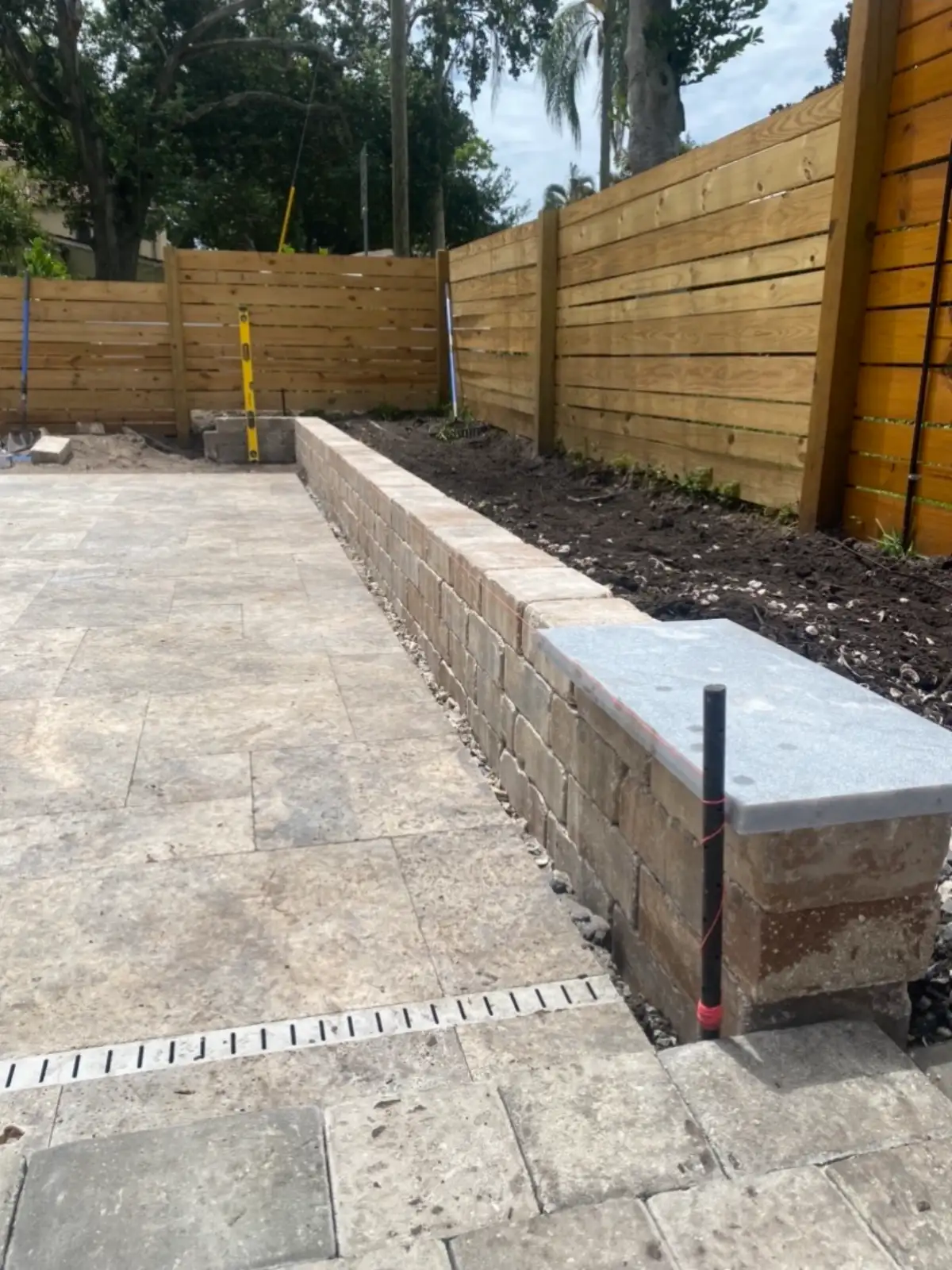
Florida's rainy season runs from June through September, and in Pinellas County, that means 60 percent of the annual rainfall arrives in a four-month window. St. Petersburg averages 7 to 9 inches of rain per month during peak summer, often delivered in intense afternoon downpours that dump 2 to 3 inches in under an hour. If your property has drainage issues, this is the season that exposes them.
The good news is that every common drainage problem in the St. Petersburg area has a proven fix. The key is diagnosing the right problem before choosing a solution. A French drain solves a different issue than a swale, and installing the wrong one wastes money without fixing the flooding. This guide covers the drainage solutions that actually work for Pinellas County properties, what each one costs, and how to figure out which one your yard needs.
Why Florida Properties Flood During Rainy Season
Most drainage problems in St. Petersburg come down to three factors working against you simultaneously.
Sandy soil with a low water table. Pinellas County sits on fine sand that drains quickly in moderate rain but becomes saturated during heavy storms. Once the water table rises within 12 to 18 inches of the surface -- which happens regularly during rainy season -- the sand loses its absorption capacity and surface water has nowhere to go. Properties near Tampa Bay, Boca Ciega Bay, or any low-lying area are especially vulnerable.
Flat topography. The St. Petersburg area is remarkably flat. Most residential lots have less than 2 feet of elevation change across the entire property. Without enough slope to direct water away from structures, runoff pools against foundations, in low spots in the yard, and along fence lines where neighboring properties drain toward yours.
Impervious surfaces. Every driveway, patio, walkway, and paver installation redirects rainwater that previously soaked into the ground. As properties add more hardscape over time, the remaining permeable areas receive proportionally more water. A 2,000-square-foot driveway and patio on a quarter-acre lot can redirect 1,200 gallons of water per inch of rainfall into whatever green space is left.
How to Diagnose Your Drainage Problem
Before spending money on a solution, you need to understand where the water comes from and where it needs to go. The best time to diagnose drainage is during a heavy rainstorm -- the problems are visible and obvious in ways they never are during dry weather.
Standing water against the foundation. If water pools within 2 feet of your home during rain, the ground is sloped toward the house instead of away from it. This is a grading problem that requires regrading the soil to create a minimum 2-percent slope away from the foundation for at least 6 feet.
Puddles that last more than 24 hours. If water stands in your yard for more than a day after rain stops, you have a low spot that needs either filling, a catch basin, or a subsurface drain to move the water to a lower discharge point.
Soggy areas that never fully dry. Chronically wet spots where grass stays spongy indicate a high water table or an underground spring. These areas may need a French drain system or, in severe cases, a dry well to manage the subsurface water.
Erosion channels. Visible wash-out paths across your yard mean surface water is moving too fast across unprotected soil. Erosion control through swales, riprap, or planted buffers slows the flow and prevents soil loss.
Drainage Solutions That Work in Pinellas County
French Drains
A French drain is a gravel-filled trench with a perforated pipe that collects subsurface water and redirects it to a discharge point. It is the most effective solution for yards with a high water table or areas where water seeps up from below rather than running across the surface.
In St. Petersburg's sandy soil, French drains are relatively easy to install because the digging is straightforward and the surrounding sand acts as a natural filter that prevents the pipe from clogging. A standard residential French drain is 12 to 18 inches wide and 18 to 24 inches deep, lined with landscape fabric, filled with washed gravel, and fitted with a 4-inch perforated PVC pipe.
Cost: $15 to $30 per linear foot installed. A typical 50-foot French drain costs $750 to $1,500.
Surface Swales
A swale is a shallow, grass-lined or rock-lined channel that directs surface water across your property to a storm drain, retention area, or property edge. Swales work by gravity -- they are graded at a gentle 1 to 2 percent slope to move water without creating erosion.
Swales are the most cost-effective drainage solution for large, flat properties in Clearwater, Largo, and St. Petersburg. They require no pipe, no gravel, and minimal maintenance. The trade-off is that they take up visible space in your yard and need periodic re-grading as the soil settles.
Cost: $5 to $15 per linear foot for grass-lined swales. Rock-lined swales run $15 to $30 per linear foot.
Catch Basins and Drain Inlets
Catch basins are box-shaped structures set flush with the ground surface that collect water from a specific low point and route it through underground pipe to a discharge location. They are the right solution when water pools in a specific area -- the low point of a driveway, the base of a slope, or the center of a patio where grade creates a collection point.
In Florida, catch basins connect to solid (non-perforated) PVC pipe that carries the collected water to the street, a storm drain, or a dry well. The basin has a grate on top that allows water in while keeping debris out, and most include a sediment trap at the bottom that catches sand and dirt before it enters the pipe.
Cost: $200 to $500 per basin installed, plus $8 to $15 per linear foot for the discharge pipe.
Regrading
Sometimes the simplest solution is the best one. Regrading involves reshaping the soil surface to direct water away from structures and toward designated drainage points. Every building code in Pinellas County requires a minimum positive grade of 6 inches over the first 10 feet from any foundation wall.
Regrading is often the first step before installing any other drainage system. If the grade around your home slopes toward the foundation, no amount of French drains or catch basins will fully solve the problem until the surface grade is corrected.
Cost: $500 to $2,000 for spot regrading around a foundation. Full-yard regrading runs $2,000 to $5,000 depending on lot size and soil volume needed.
Dry Wells
A dry well is an underground chamber that collects water from downspouts, French drains, or catch basins and allows it to slowly percolate back into the ground. They work well in St. Petersburg because the sandy soil has high percolation rates once you get below the saturated surface layer.
Dry wells are typically 3 to 4 feet in diameter and 3 to 4 feet deep, filled with gravel or fitted with a prefabricated chamber. They are the right solution when you have nowhere to discharge water at the surface -- no storm drain nearby, no swale easement, and no lower property edge to direct flow toward.
Cost: $500 to $1,500 per dry well installed.
When to Install Drainage Before Rainy Season
The ideal window for drainage work in St. Petersburg is March through May -- after the winter dry season when the ground is workable but before the summer rains expose every weakness. Installing a French drain in July means working in saturated soil that caves in as you dig, which doubles labor time and costs.
If you have missed the spring window, drainage work is still possible during rainy season, but expect it to take longer and cost 15 to 25 percent more due to the wet conditions. The alternative -- waiting until October -- means enduring another full rainy season of flooding, and the cumulative damage from four months of standing water against your foundation can cost more than the drainage fix itself.
Drainage and Your Landscape
Drainage improvements often pair with other landscape upgrades. A regrading project is the perfect time to install new sod because you are already disturbing the topsoil. A French drain along a fence line can double as the base for a retaining wall that adds usable flat space to a sloped yard. A catch basin at the low point of your patio connects naturally to a landscape redesign that incorporates rain gardens or planted bioswales.
The most cost-effective approach is to combine drainage work with any other landscape project you have planned. Mobilizing equipment and crew once instead of twice saves 20 to 30 percent on the total project cost.
The Bottom Line
Florida's rainy season does not have to mean a flooded yard. Every drainage problem in Pinellas County has a proven, cost-effective solution. The key is diagnosing the specific issue -- high water table, poor grading, insufficient runoff management, or a combination -- and choosing the right fix before the heavy rains arrive in June.
Hound Dog Landscaping provides drainage solutions, erosion control, and complete landscape design services throughout St. Petersburg, Clearwater, Largo, Seminole, and all of Pinellas County. We handle everything from simple regrading to full French drain systems and hardscape drainage integration. Request a free estimate or call 757-634-6562 to schedule a drainage evaluation before rainy season starts.